Sofiia's interest in
Aalto's Design and Media program was not accidental. The school captured her with their standards, curriculum, and the study environment, which she felt drawn to, but the application process was at the same time hard to decode.
"The question that worried me the most was whether my application to Aalto would be understood and whether my ideas were aligned with the admissions team's and the school's ideology."
Even after her first attempt, she could not clearly identify what had been missing.
"It was unclear when an idea was too far-fetched and when it was too far outside the point of the assignment."
This ambiguity was part of what made Aalto both attractive and difficult. The assignments were open, but the evaluation criteria were not tangible.
Joining the preparation course was, for Sofiia, an attempt to move from guessing to understanding. She had already experienced disappointment once. This time, she wanted structure, feedback, and a clearer sense of direction.
"I had to deepen my understanding of design, ideation, and practice my skills on similar tasks. The instructions for the application assignments are very vague and open, which is why I wanted more feedback during my application process."
What changed during the course was not just the work itself, but how she began to interpret her own process.
"I started to see where I might have missed the idea with my previous submissions. I learned a lot about what aspects the school valued more."
The course did not remove uncertainty, but it made it more readable.
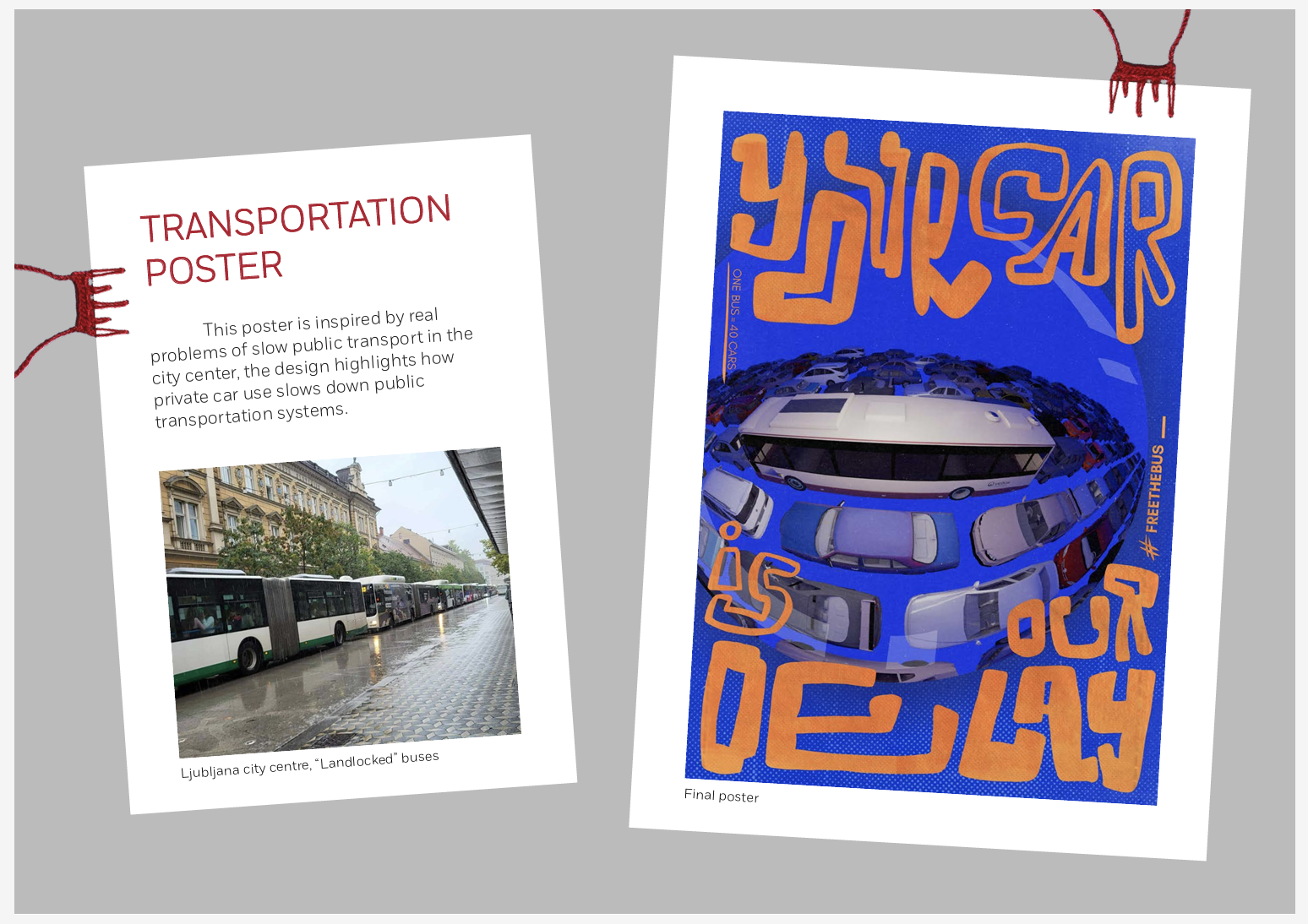
Sofiia's SDS course work: A poster to describe some specific issue amongst transportation. This is also how she presented the poject in her KABK-application portfolio.
Empty space, drag to resize
The experience of applying was not neutral. It involved repeated cycles of hope, effort, and outcome. To Aalto the process involves preliminary assignment and intake assignment phases, and later the final interview.
When she was not again selected for the final interview stage of Aalto's admissions process, her reaction was more complex rather than simple disappointment.
"It was definitely disappointing to hear the news about rejection, but it also felt different this second time."
After a second attempt, the result carried a different meaning.
"I was pretty sad, but also relieved, because after the first attempt I thought I was the reason for my rejection. But with the second try, it showed that maybe I simply wasn't what they were looking for."
This shift changed how she interpreted admissions decisions. It was no longer only about improvement, but also about fit. In the final stage of admissions, all applicants have a similar level of skills. Some may be more experienced with some practices, some in other, but all are talented and potential applicants. It also depends on the evaluators: what kind of group of talents and ideas they emphasise in the evaluation.
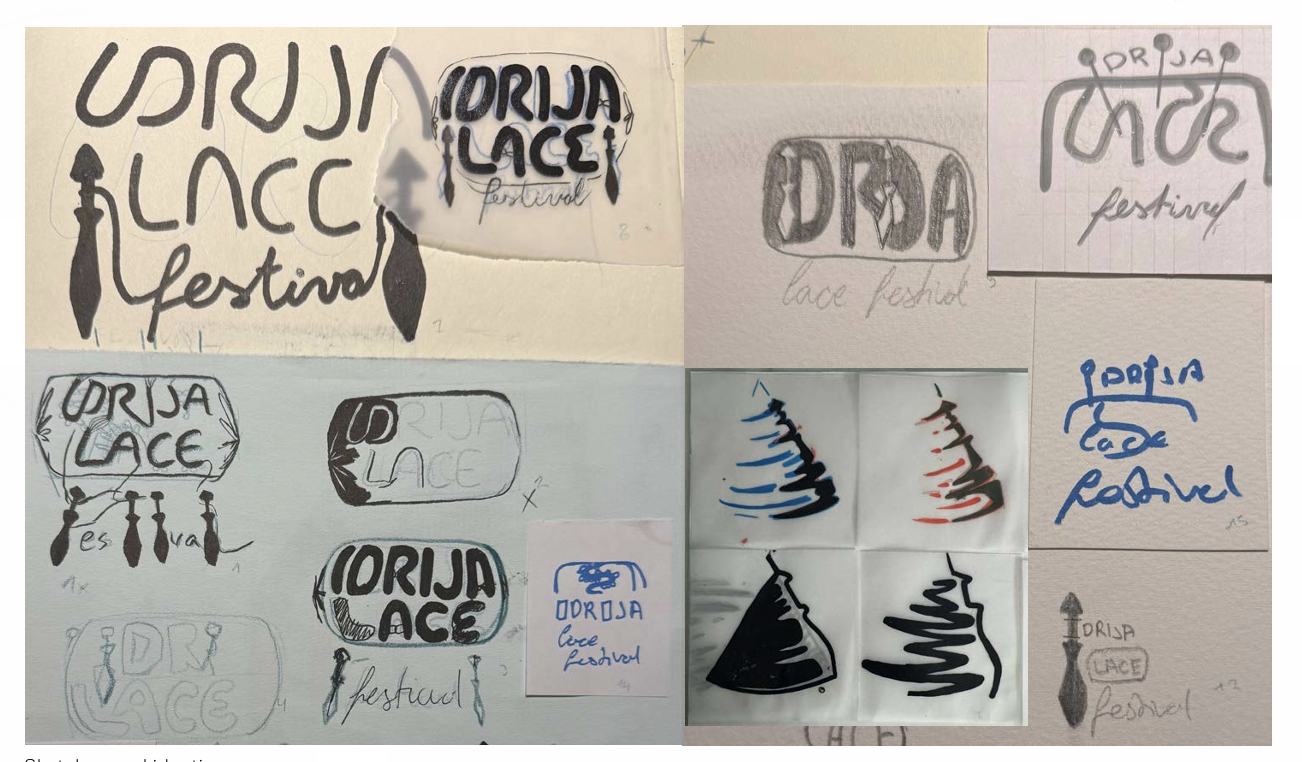
These are Sofiia's sketches to her Preliminary Assignment submission to Aalto University Design and Media program. The assignment asked applicants to choose a local festival, study it's current visual identity, and design an new poster to promote the festival. Also, a gateway model representing this new visual identity and marking the spot for people to enter the festival grounds was to be designed and modelled.
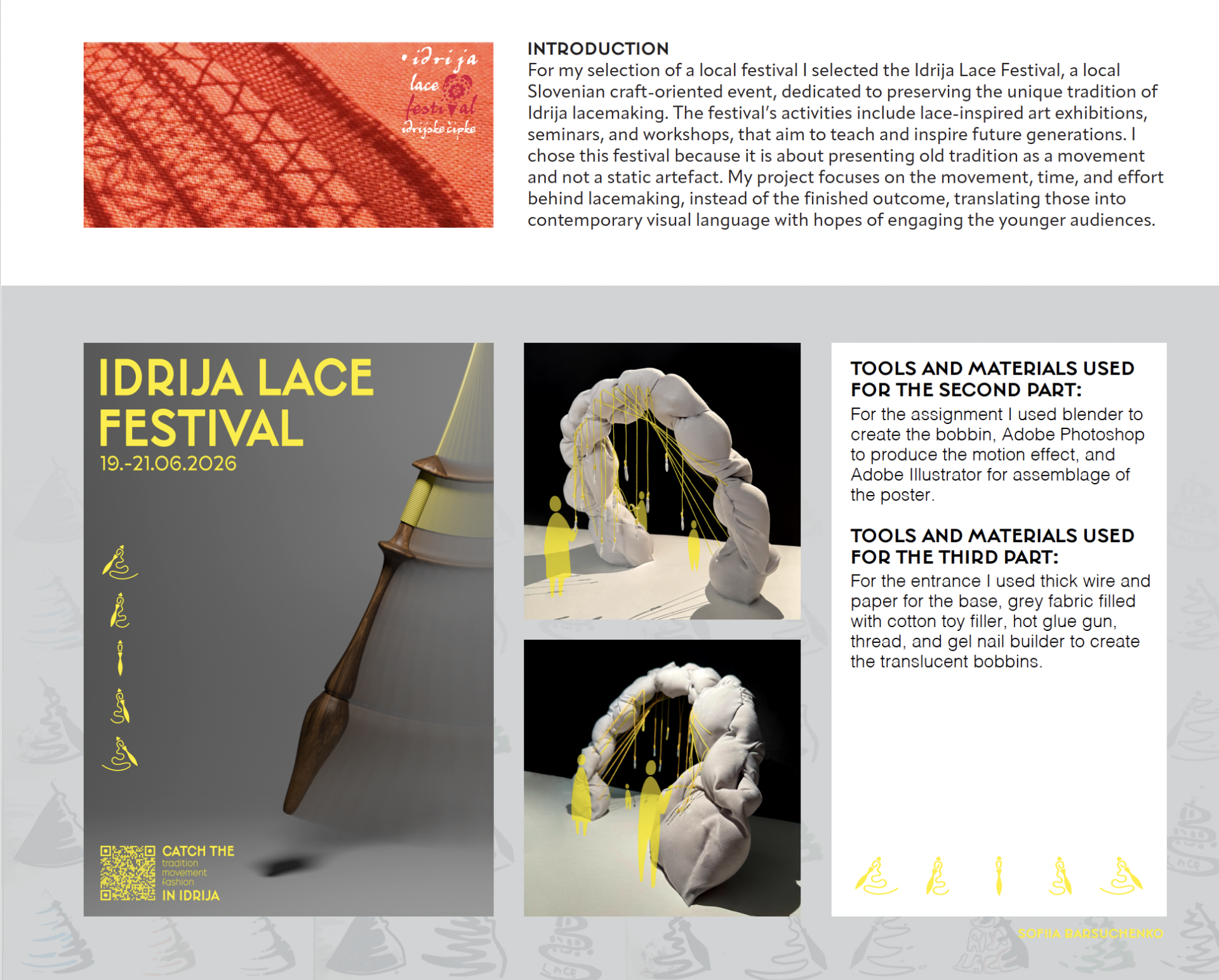
Sofiia chose a local lace festival, and chose the flying bobbin as the visual focus to the poster, not the lace product itself. The gate represents the lace pillow the bobbins rest on. The lace will be built and pinned onto the pillow as the bobbins make the knots and movements. Her idea was to focus to the making, instead of the end result. She was invited to the second phase of the application process.
Empty space, drag to resize
Looking back, Sofiia describes the application processes less as a single trajectory and more as parallel interpretations of the same work.
The next step was not interpretation anymore, but translation: how to turn her thinking into a portfolio that could be read clearly in different contexts.
While continuing the Aalto process, Sofiia was also applying to different Dutch design schools, including KABK.
This created two parallel ways of presenting herself as a designer: one through timed problem solving, and one through curated communication. It was not necessarily easier, but more portfolio driven and less dependent on interpreting abstract assignment expectations, even if the Dutch schools also have some mandatory tasks they ask applicants to work on.
When she received an offer from KABK, the experience contrasted sharply with the uncertainty of other applications.
"I was very relieved when I got accepted into KABK."
At the same time, she did not view the different outcomes as contradictory. Instead, they reinforced the idea that design school admissions are not uniform.
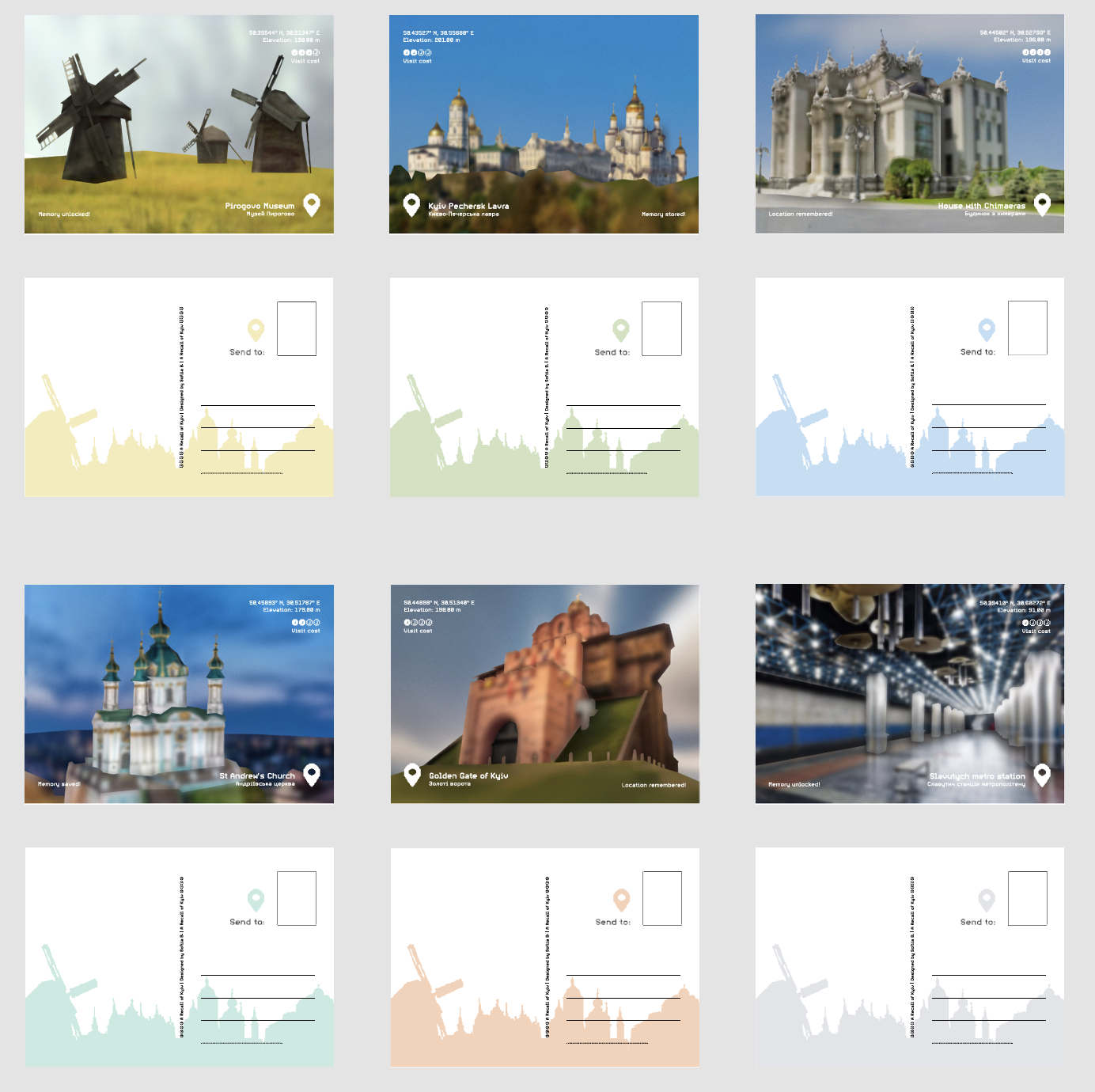
Before KABK interview Sofiia was asked to work on a set of tasks as well. This was a quick task, she had only one day to work on it: ""I had to design a set of postcards with building/piece of architecture on each of them. I thought about doing something more abstract-y like an old game or like a foggy memory of the place. The idea is that in this digital world everybody already took all the pretty pictures of the landmarks, so the postcards are more like a vague reminder about the visit."
Empty space, drag to resize
Not every design school values the same signals, and a strong applicant can be read in entirely different ways depending on context.
Tune in to the next part of Sofiia's interview and learn how she built and conquered her portfolio application.