For Kio, the interest in Aalto did not begin with a curriculum or a ranking. It began with something much smaller and more visual.
"I first became interested in the logo design of Aalto University, and I have an interest in Finland, so I decided to visit Finland and the university on my own. I really thought it was a place where I could feel comfortable, and where the design was the kind I love."
What kept her attention was the way the school framed design as something larger than craft.
"For me, Aalto University's awareness of social problems and its multidisciplinarity were really interesting. After learning about Aalto, I started to study design, and every step opened my eyes, because design was much deeper, broader, and freer than I had thought before."
That early curiosity mattered, because the road ahead was not short. Kio's first application to Aalto ended in a rejection. Rather than reading it only as a setback, she used it as a question to sit with.
"After the first rejection, I tried to think about the why part, and to feel honestly about the design around me. I think that changed my attitude a bit."
Before joining the course, Kio's biggest uncertainty was not motivation. It was whether someone without a traditional art background could realistically reach a school as competitive as Aalto.
"Before I studied, I didn't have the technical skills, so I was not sure I could even start studying design and enter such a competitive university. I was not a person who drew a lot or had good knowledge about design, but I had strong curiosity for it."
The application process itself added another layer of uncertainty, because the Finnish system worked nothing like the one she knew from Japan.
"At that time, the Finnish application process was really different from Japan's, so it was unclear at first. It turned out to be a very understandable, systematic way of doing things, but I didn't even know there were three phases of entrance assignments: the preliminary assignment, the intake assignment, and the interview. I didn't know what kind of features each of them had."
When she decided to prepare seriously, Kio made a deliberate choice not to take an art preparation course at home in Japan. She wanted something specific: real feedback, design fundamentals, and an environment connected to the schools she was actually aiming for.
"I felt the need to study the basics of design, and I wanted to learn through actual feedback. It was also important for me to study Finnish design, and to study in English. That's why I didn't choose an art preparation course in Japan and chose SDS instead."
A student story she found online made the decision feel even more personal.
"I read the student blog, and there was someone who had a similar feeling to mine and got accepted to Aalto. I was also fascinated by the student work."
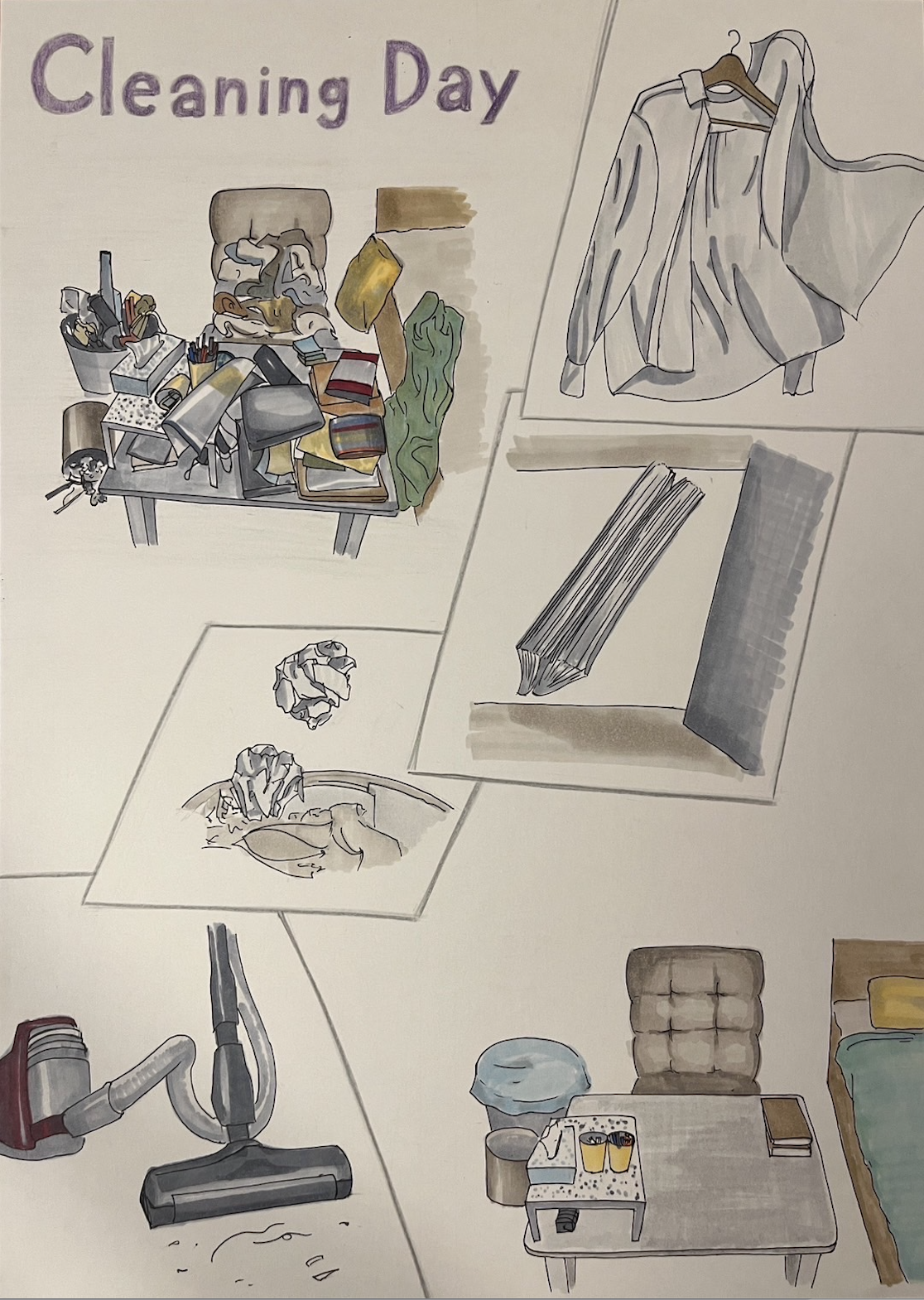
Kio joined SDS for multiple courses and started with the Design Foundation course. One task asked students to create a visual timeline of a cleaning day, and this was Kio's first attempt. She draws well and her idea comes through clearly, but the result is close to what you might expect from this kind of task. See her second attempt below, after she had explored more of the possibilities of visual communication.
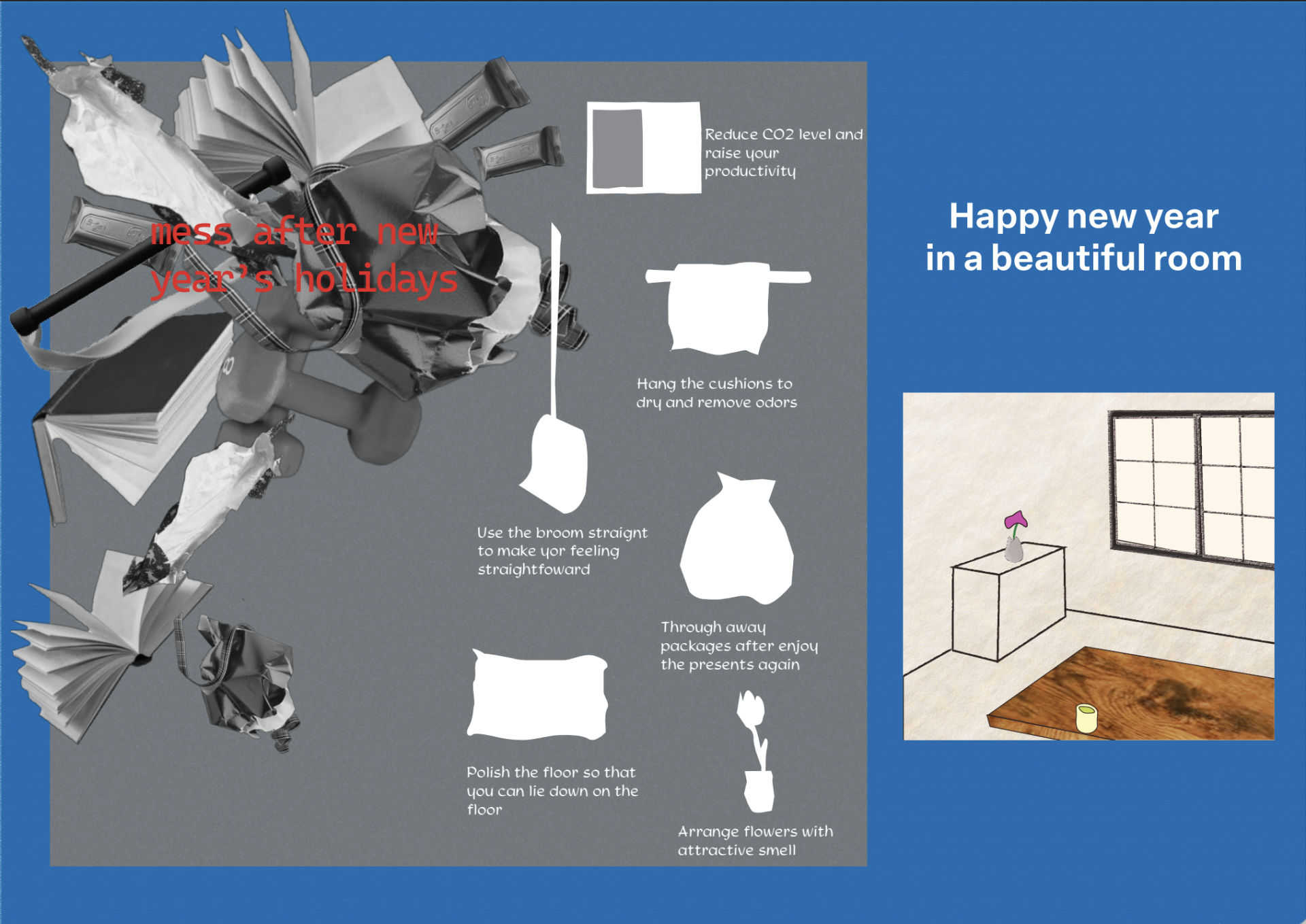
Kio returned to the cleaning day assignment on the BA in Design preparation course. Her ideation, compositional ideas and visual communication elements in this second version give the viewer more to see than just the assignment's name expects. This is what learning visual skills means: experimenting, doing, learning from what you have done and then using this new understanding in future works.
Empty space, drag to resize
The most important change during the course was not a single project. It was a belief about where creativity comes from.
"One big change in my mind is that your creativity can grow and mature through study. Ability related to design is sometimes thought to be inherent, quite often in Japan. But through the course, I came to believe that I can actually develop my ideation, my technical skills, and even my own interests."
One moment in particular stayed with her: a graphic design task to design a book's dust cover, where she took a risk on something abstract and wasn't sure it would land.
"I thought a lot and finally submitted quite abstract work. I myself was not sure whether it worked or not. But the teacher's feedback was surprising. They clearly understood what I meant. After that, I had much more interest in imagining graphic design in my mind."
That experience pointed to the single thing she feels she could not have done without the course: turning ideas into work that actually communicates.
"I had my own ideas, and I think my ideas are creative. But without the course, it would have been difficult to show the uniqueness of my design."
The result is a different relationship with her own ability.
"I am more confident in my design perspective than before. I'm more aware of the reasoning and the concept behind a design. My imagination has changed too. I became able to imagine what if… design in everyday life. And in the BA in Design preparation course I had two weeks for each homework, so I got used to deciding and producing an output within a limited time, which was good practice for the application."
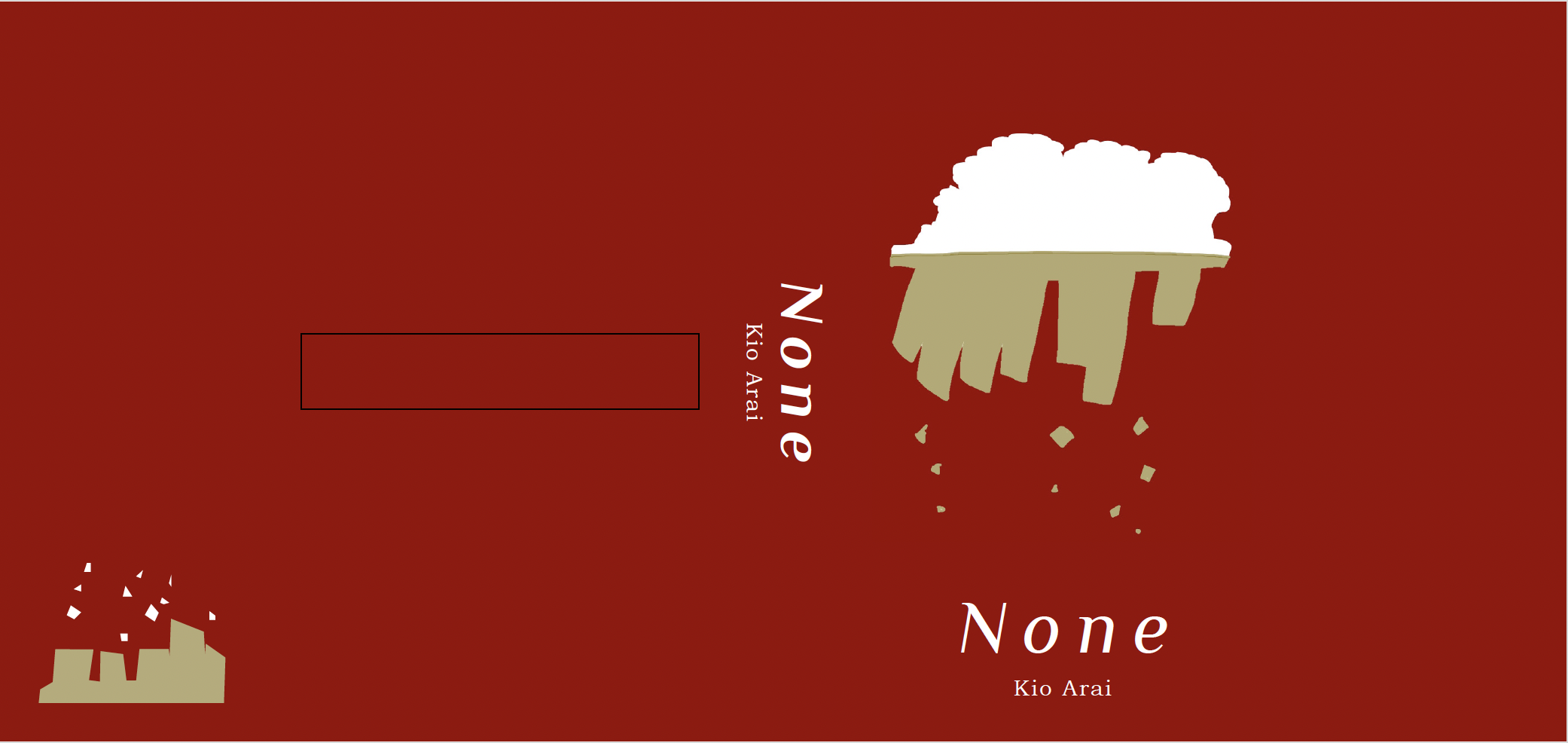
Kio's book cover return. The task was to design a book cover for an imaginary book titled "none". It should include the front, spine, back and front and back flaps. The black rectangular frames indicate space for additional text.
Empty space, drag to resize
Choosing to apply to Aalto a second time was not an obvious decision. Kio was already studying architecture, a field she found genuinely interesting. But she wanted something that architecture did not fully give her.
"I thought it had to be a turning point. Architecture is interesting too, but I wanted to study design, and the education of design. I thought I could do better the second time by reflecting, studying more, and learning more about Japanese design, which is my root."
The learning environment itself was part of the appeal.
"To be honest, the studying environment is something I have an interest in. In Japan, we don't place so much importance on the well-being of students. You just sleep less and keep building architecture models. I think hard work is important, but we should care more about how students learn. I have a passion to experience Aalto student life myself, so that I can help make some change in the Japanese study environment."
When the acceptance finally came, it meant more than admission.
"I feel like I now have a place to experiment and play a lot with design, to understand more deeply what design is all about. At the same time, I'm so happy, because I can study design and create something for others."
Empty space, drag to resize
Kio's story is, in many ways, an argument against a common idea: that creativity is something you are simply born with or without. Her journey shows the opposite: that curiosity, feedback, determination and honest reflection can grow a designer over time, even across two very different educational cultures.
Read part two to see the application assignments that got her a study place in Aalto Design and Media program in Finland!